


Page 23 - Designing Ways 256
P. 23
scarce regions. It is known that almost 60%   opportunity to bring financial security to
           of female refugees suffer period poverty   refugee women who can be paid livable
           problems rather than spend financial   wages for pad manufacturing.   dw
           support on food or baby diapers. Most
           of them come from strictly religious   Technical sheet
           countries  that  see  inserting  tampons   •   Location: Greece, Jordan, Lebanon,
           as taboo. This  inspired her to design a   or Ethiopia
           product that can protect fundamental   •   Year: 2021 • Typology: Product
           human rights to water, sanitation, and   design
           health for menstruators from 12 to 24   •   Status: Completed
           years old, who suffer language and culture   •   Designer: Cheuk LaamWong
           barriers and have limited financial ability.   •   Render Artist: RubyMaky
           At first, Cheuk Laam studied elements like   •   Pad Makers: Rose Wei, Larry Turner
           a yoyo, pseudosphere, perpetual motion,   •   Partnership: Phoenicia Finesse
           gyroscope, and centripetal acceleration.
           Then she found out that buoyant force   www.waveeedesign.com/work-1/
           will reduce water usage depending on the      looopcan
           size of an object immersed in liquid. This
           inspiration actually comes from observing
           how her British flatmates soaked their
           teastained cups. Seeing them overlay a cup
           on another cup for soaking the inner wall
           with less water. Washing paddle alteration
           and tin can adaption are suggestions from
           her beloved tutors KC and Mike.
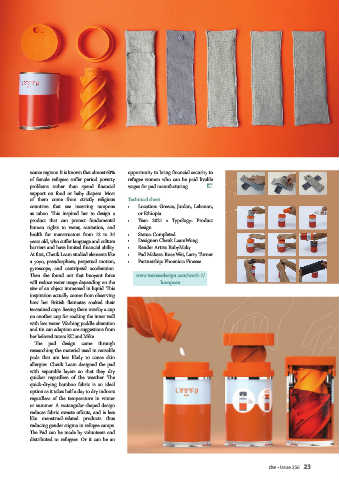
             The pad design came through
           researching the material used in reusable
           pads  that  are  less  likely  to  cause  skin
           allergies. Cheuk Laam designed the pad
           with separable layers so that they dry
           quicker regardless of the weather. The
           quick-drying  bamboo  fabric  is  an  ideal
           option as it takes half a day to dry indoors
           regardless of the temperature in winter
           or summer. A rectangular-shaped design
           reduces fabric owaste offcuts, and is less
           like menstrual-related products thus
           reducing gender stigma in refugee camps.
           The Pad can be made by volunteers and
           distributed  to  refugees.  Or  it  can  be  an


                                                                                                    dw • Issue 256   23

