


Page 75 - Designing Ways 242
P. 75
Sino-Italian Cultural

                                                                                 Exchange City


                                                                           Reception Center


                                                                                             Chengdu, China


                                                                  o introduce this meeting of culture, aoe created a Cultural
                                                                  Exchange City Reception Center in the city where it all begun.
                                                            TThe marriage of the Italian and Sino style was at the heart of
                                                             the project to illustrate the cultural mix and was adapted to merge the
                                                             structure and its surrounding.
                                                             Chengdu, hailed as the land of abundance, has a civilization history of
                                                             4,500 years old and a city construction history of 2,300 years old. In
                                                             the 13th century, Marco Polo came to Chengdu, the Corridor Bridge,
                                                             the Jinjiang River and the cloth of ancient Sichuan became the most
                                                             colourful parts of his travelogue. In the 21st century, against the
                                                             background of the Belt and Road Initiative, the planning of Chengdu
                                                             Tianfu Cultural and Creative City came into being, and the Sino-
                                                             Italian Cultural Exchange City Reception Center is an important
                                                             part of the City, aiming to build a platform for cultural exchange
                                                             and civilization interchange between the two countries. The project
                                                             is located about 36 kilometres from the centre of Chengdu, planned
                                                             to cover an area of 17,815 square metres, with a construction area
                                                             of 2,107 square metres. At the platform of the exhibition hall, the
                                                             creative group projects on the east side and the natural landscape of
                                                             Yanqi Wetland are treats for visitors.
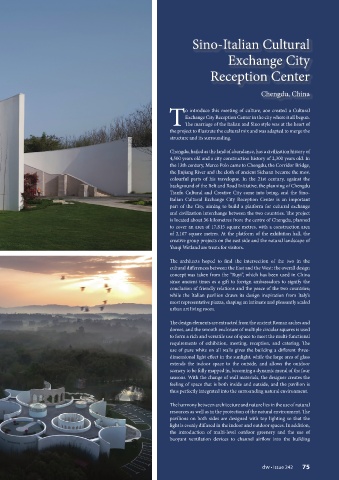
                                                             The architects hoped to find the intersection of the two in the
                                                             cultural differences between the East and the West: the overall design
                                                             concept was taken from the “Ruyi”, which has been used in China
                                                             since ancient times as a gift to foreign ambassadors to signify the
                                                             conclusion of friendly relations and the peace of the two countries;
                                                             while the Italian pavilion draws its design inspiration from Italy’s
                                                             most representative piazza, shaping an intimate and pleasantly scaled
                                                             urban art living room.

                                                             The design elements are extracted from the ancient Roman arches and
                                                             domes, and the smooth enclosure of multiple circular squares is used
                                                             to form a rich and versatile use of space to meet the multi-functional
                                                             requirements of exhibition, meeting, reception, and catering. The
                                                             use of pure white on all walls gives the building a different three-
                                                             dimensional light effect in the sunlight, while the large area of glass
                                                             extends the indoor space to the outside, and allows the outdoor
                                                             scenery to be fully mapped in, becoming a dynamic mural of the four
                                                             seasons. With the change of wall materials, the designer creates the
                                                             feeling of space that is both inside and outside, and the pavilion is
                                                             thus perfectly integrated into the surrounding natural environment.

                                                             The harmony between architecture and nature lies in the use of natural
                                                             resources as well as in the protection of the natural environment. The
                                                             pavilions on both sides are designed with top lighting so that the
                                                             light is evenly diffused in the indoor and outdoor spaces. In addition,
                                                             the introduction of multi-level outdoor greenery and the use of
                                                             buoyant ventilation devices to channel airflow into the building


                                                                                                  dw • Issue 242  75

