


Page 32 - Designing Ways 243
P. 32
DESIGN
              THINKING


              Design Thinking meets the Bloom’s Taxonomy of Learning, and
                          the Value of Contemporary School Pedagogies


             Deidré Spencer: English, Visual Art, Design and Technology Teacher, Curriculum Leader,

                                            IEB Examiner, Textbook Writer


             At the core of the way in which young   educationalists are constantly being   A group of cognitive psychologists,
           minds are being trained to contribute to   introduced to new buzz words and ways   curriculum theorists and instructional
           a sustainable future are the pedagogies   of doing, to accommodate contemporary   researchers,  and  testing  and assessment
           embedded in institutes of learning. The   identified needs. They attend endless   specialists published in 2001, a revision
           value of Design Thinking, defined here as   training sessions, are advised to abandon   of Bloom’s Taxonomy which pointed to a
           a collection of mindsets and philosophies   a previous trend, and to implement   more dynamic conception of classification
           all wrapped up in one term, is highlighted   the  new  trend,  on  an  ongoing  basis.   to  describe  the  cognitive  processes  by
           as an indispensable skill that is used at   Frequently, any new-found educational   which thinkers encounter and work with
           universities, in organisations, by artists   movement is accompanied by new forms   knowledge (Armstrong, P. 2010).
           and designers, by engineers, and by   of administration which add to an already
           many in the business and corporate   over-burdened classroom environment.   Today, the Bloom’s Taxonomy, theo-
           world. Classroom implementation is very   While some educators will try their best   retically, underpins the outcomes of any
           slowly finding its stride, but the marriage   to accommodate each, most recently   learning environment, and educators
           between the demands of the curriculum   introduced, pedagogy, truth be told, most   are accountable in ensuring that they
           and the value that Design Thinking offers,   will revert to their own core, traditionally   are teaching and assessing across the
           can be more quickly cemented by aligning   held beliefs of what is best practice in   proposed levels of thinking and doing,
           the Bloom’s Taxonomy of Learning to the   their own classrooms.      embedded in the taxonomy. At its very
           heart of Design Thinking. This will fulfil   One  theory of  cognitive  processing,   core,  within  most  Educational  Systems,
           the need for developing strong curiosities   however, has lasted the test of time:   the Bloom’s Taxonomy suggests that ed-
           and fostering the desire  to  understand   namely the Bloom’s Taxonomy for   ucators and learners allocate only 20%
           and solve complex problems.        Teaching, Learning, and Assessment. In   of  their  efforts  to  the  lowest  levels  of
             Education is a field that seems to fall   1956, Benjamin Bloom with collaborators   knowledge, namely levels 1 and 2. The
           victim to  anything and  everything that   Max Englehart, Edward Furst, Walter   skill of remembering and understanding
           is trending in academic research. Due to   Hill, and David Krathwohl published a   information is deemed the first step in
           the changeable nature of human beings,   framework for categorising educational   cognitive processing, but is acknowledged
             and the way that the slippery economy,   goals, and this framework has been   as a vital grounding for young develop-
               environment, society, and culture   applied by generations of teachers and   ing minds. Embedded into this 20% is a
                impacts on spaces of learning,   college instructors in their teaching.   negation of the outdated traditional view


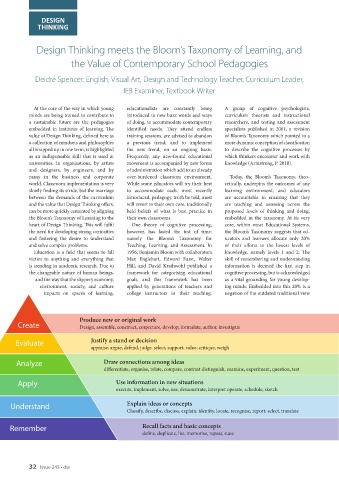
                             Produce new or original work
       Create                Design, assemble, construct, conjecture, develop, formulate, author, investigate


       Evaluate                  Justify a stand or decision
                                 appraise, argue, defend, judge, select, support, value, critique, weigh

       Analyze                        Draw connections among ideas
                                      differentiate, organise, relate, compare, contrast distinguish, examine, experiment, question, test

       Apply                              Use information in new situations
                                          execute, implement, solve, use, demonstrate, interpret operate, schedule, sketch

     Understand                               Explain ideas or concepts
                                              Classify, describe, discuss, explain, identity, locate, recognise, report, select, translate


     Remember                                      Recall facts and basic concepts
                                                   define, duplicate, list, memorise, repeat, state


           32     Issue 243 • dw

