


Page 54 - Designing Ways 238
P. 54
SHAPES


                                                                                improve the perceived sense of safety
                          Calgary 9 Block Project                               and vibrancy in the area. Under the
                                                                                supervision  of  Professor  Mauricio
                                   Calgary, Canada                              Soto-Rubio and robotics specialist Guy
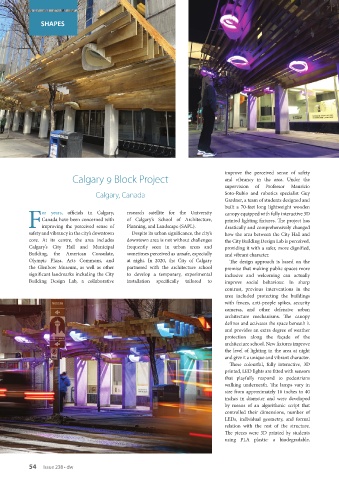
                                                                                Gardner, a team of students designed and
                                                                                built a 70-feet long lightweight wooden
                or years, officials in Calgary,   research satellite for the  University   canopy equipped with fully interactive 3D
                Canada have been concerned with   of Calgary’s School of Architecture,   printed lighting fixtures. The project has
           Fimproving the perceived sense of   Planning, and Landscape (SAPL).  drastically and comprehensively changed
           safety and vibrancy in the city’s downtown   Despite its urban significance, the city’s   how the area between the City Hall and
           core. At its centre, the area includes   downtown area is not without challenges   the City Building Design Lab is perceived,
           Calgary’s  City  Hall  and Municipal   frequently seen in urban areas and   providing it with a safer, more dignified,
           Building, the American Consulate,   sometimes perceived as unsafe, especially   and vibrant character.
           Olympic Plaza, Arts Commons, and   at night. In 2020, the City of Calgary   The design approach is based on the
           the Glenbow Museum, as well as other   partnered with the architecture school   premise that making public spaces more
           significant landmarks including the City   to develop a temporary, experimental   inclusive and welcoming can actually
           Building Design Lab, a collaborative   installation  specifically  tailored  to  improve social behaviour. In sharp
                                                                                contrast, previous interventions in the
                                                                                area included protecting the buildings
                                                                                with fences, anti-people spikes, security
                                                                                cameras, and other defensive urban
                                                                                architecture mechanisms. The canopy
                                                                                defines and activates the space beneath it
                                                                                and provides an extra degree of weather
                                                                                protection along the façade of the
                                                                                architecture school. New fixtures improve
                                                                                the level of lighting in the area at night
                                                                                and give it a unique and vibrant character.
                                                                                  These colourful, fully interactive, 3D
                                                                                printed, LED lights are fitted with sensors
                                                                                that playfully respond to pedestrians
                                                                                walking underneath. The lamps vary in
                                                                                size from approximately 16 inches to 40
                                                                                inches in diameter and were developed
                                                                                by means of an algorithmic script that
                                                                                controlled their dimensions, number of
                                                                                LEDs, individual geometry, and formal
                                                                                relation with the rest of the structure.
                                                                                The pieces were  3D printed by students
                                                                                using PLA plastic: a biodegradable,


           54     Issue 238 • dw

