


Page 80 - Designing Ways 254
P. 80
Louis-Hémon


                                             House


                                      Montréal, Canada


           A small brick house located on Louis-Hémon Street in Montreal
           recently  underwent  a  major  transformation.  This  residence  had
           remained virtually unchanged since its construction in the 1950s.
           The programme consisted of creating new living spaces that are
           bright, pleasant, and more adapted to a contemporary lifestyle, while
           respecting the original character of the residence.

           Concept and strategies
           Taking place in the heart of Villeray, a lively, family-oriented
           neighborhood on a human scale, it was clear to the agency that it
           was necessary to find the volumetric balance between the existing
           part of the building and the architectural addition, while promoting
           harmony within the neighbourhood. Furthermore, it was essential
           to preserve key elements of the existing architecture such as the roof
           slopes, the dormer, and the characterful volume of the dwelling. New
           finishing materials were proposed in order to infuse character and
           echo the new installation. In addition to these modifications, the
           attic, an unused and cramped space, has been removed. It is through
           this decompartmentalisation that the architectural potential took on
           its full meaning.

           "This gesture was able to bring out the quality of natural light
           and maximise the contribution of the house, while enhancing its
           character," says Marie Eve Issa, founding designer of ISSADESIGN.

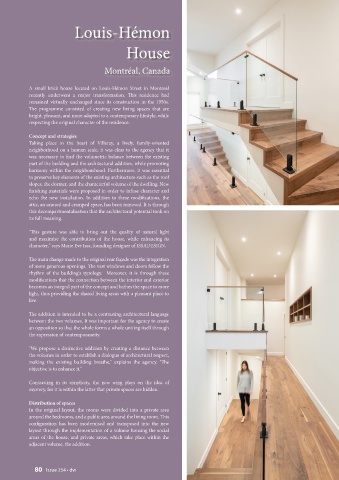
           The main change made to the original rear façade was the integration
           of more generous openings. The vast windows and doors follow the
           rhythm of the building's typology.  Moreover, it is through these
           modifications that the connection between the interior and exterior
           becomes an integral part of the concept and bathes the space in more
           light, thus providing the shared living areas with a pleasant place to
           live.

           The addition is intended to be a contrasting architectural language
           between the two volumes. It was important for the agency to create
           an opposition so that the whole forms a whole uniting itself through
           the expression of contemporaneity.

           "We propose a distinctive addition by creating a distance between
           the volumes in order to establish a dialogue of architectural respect,
           making the existing building breathe," explains the agency. "The
           objective is to enhance it."

           Contrasting in its simplicity, the new wing plays on the idea of
           mystery, for it is within the latter that private spaces are hidden.

           Distribution of spaces
           In the original layout, the rooms were divided into a private area
           around the bedrooms, and a public area around the living room. This
           configuration has been modernised and transposed into the new
           layout through the implementation of a volume housing the social
           areas of the house, and private areas, which take place within the
           adjacent volume, the addition.


             80     Issue 254 • dw

