


Page 54 - Designing Ways 260
P. 54
PATTERNS


                      Patterns, colours and curves.


                               by Design Team Fabrics


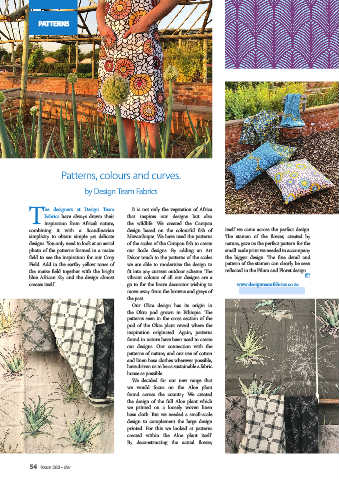
                 he  designers at Design  Team   It is not only the vegetation of Africa
                 Fabrics  have  always  drawn  their   that inspires our designs but also
           Tinspiration from Africa’s nature,   the wildlife. We created the Carapau
           combining it with a Scandinavian   design based on the colourful fish of   itself we came across the perfect design.
           simplicity to obtain simple yet delicate   Mozambique. We have used the patterns   The stamen of the flower, created by
           designs. You only need to look at an aerial   of the scales of the Carapau fish to create   nature, gave us the perfect pattern for the
           photo of the patterns formed in a maize   our Scale designs. By adding an Art     small  scale print we needed to accompany
           field to see the inspiration for our Crop   Décor touch to the patterns of the scales   the bigger design. The fine detail and
           Field. Add in the earthy yellow tones of   we are able to modernise the design to   pattern of the stamen can clearly be seen
           the maize field together with the bright   fit into any current outdoor scheme. The   reflected in the Filum and Floret design.
           blue African sky and the design almost   vibrant colours of all our designs are a                dw
           creates itself.                    go to for the brave decorator wishing to   www.designteamfabrics.co.za
                                              move away from the browns and greys of
                                              the past.
                                               Our Okra design has its origin in
                                              the Okra pod grown in Ethiopia. The
                                              patterns seen in the cross section of the
                                              pod  of  the  Okra  plant  reveal  where  the
                                              inspiration originated. Again, patterns
                                              found in nature have been used to create
                                              our designs. Our connection with the
                                              patterns of nature, and our use of cotton
                                              and linen base clothes wherever possible,
                                              have driven us to be as sustainable a fabric
                                              house as possible.
                                               We decided for our new range that
                                              we would focus on the Aloe plant
                                              found across the country. We created
                                              the design of the full Aloe plant which
                                              we printed on a loosely woven linen
                                              base cloth. But we needed a small-scale
                                              design to complement the large design
                                              printed. For this we looked at patterns
                                              created within the Aloe plant itself.
                                              By  deconstructing the  actual flower,


           54     Issue 260 • dw

