


Page 76 - Designing Ways 260
P. 76
Free Plane
           Based on the spatial pattern, functional areas are connected by
           transitional spaces. Taking advantage of the existing steel structure
           space on the large balcony, the design team integrated the family
           communication centre with the landscape balcony to form a natural
           and comfortable dining space.
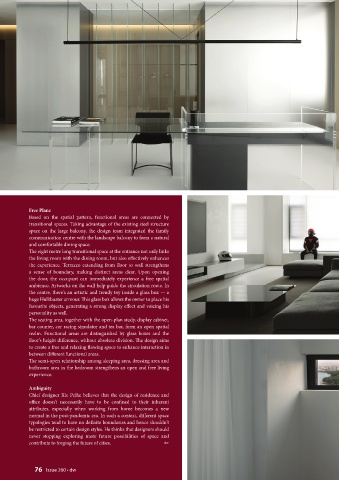
           The eight metre long transitional space at the entrance not only links
           the living room with the dining room, but also effectively enhances
           the experience. Terrazzo extending from floor to wall strengthens
           a sense of boundary, making distinct areas clear. Upon opening
           the door, the occupant can immediately experience a free spatial
           ambience. Artworks on the wall help guide the circulation route. In
           the centre, there's an artistic and trendy toy inside a glass box — a
           huge Hulkbuster armour. This glass box allows the owner to place his
           favourite objects, generating a strong display effect and voicing his
           personality as well.
           The seating area, together with the open-plan study, display cabinet,
           bar counter, car racing simulator and tea bar, form an open spatial
           realm. Functional areas are distinguished by glass boxes and the
           floor's height difference, without absolute division. The design aims
           to create a free and relaxing flowing space to enhance interaction in
           between different functional areas.
           The semi-open relationship among sleeping area, dressing area and
           bathroom area in the bedroom strengthens an open and free living
           experience.

           Ambiguity
           Chief designer Xie Peihe believes that the design of residence and
           office doesn't necessarily have to be confined to their inherent
           attributes, especially when working from home becomes a new
           normal in the post-pandemic era. In such a context, different space
           typologies tend to have no definite boundaries and hence shouldn't
           be restricted to certain design styles. He thinks that designers should
           never stopping exploring more future possibilities of space and
           contribute to forging the future of cities.     dw


             76     Issue 260 • dw

