


Page 92 - Designing Ways 260
P. 92
Rolo


                                    Morin-Heights, Canada


              n a natural setting at the limits of constructability, Rolo offers
              a landscape approach to an architectural project. Located in
           Ithe Laurentian region of Quebec, and situated on a steep slope,
           the property is characterised by large, rocky outcrops and offers
           clear views of the Laurentian horizon. Before the intervention, the
           owners had created a variety of scattered and fragmented amenity
           areas on site, linked together by winding hiking trails that skirt along
           the steep cliffs of the mountainous terrain. Due to the organic and
           temporary nature of these initial site uses, their specificity informed
           the beginning of the project.

           The conceptual premises of the project were therefore anchored to
           these temporary occupancy structures that the owners had developed
           over the years. Along the contours of a rocky plateau they already
           occupied, the location of the residence was organised in a strategic
           manner in order to maintain some of their existing "lifestyle". Rather
           than dominating its surroundings, or reconfiguring its site, the
           architecture was developed to observe the landscape and respect its
           original state prior to the intervention.

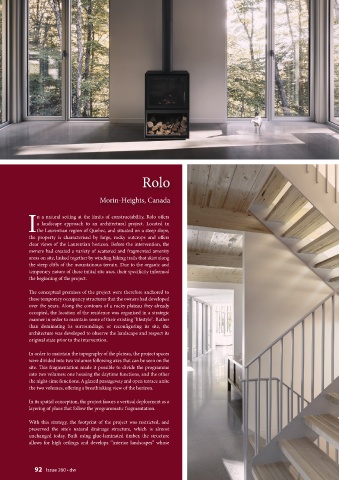
           In order to maintain the topography of the plateau, the project spaces
           were divided into two volumes following axes that can be seen on the
           site. This fragmentation made it possible to divide the programme
           into two volumes: one housing the daytime functions, and the other
           the night-time functions. A glazed passageway and open terrace unite
           the two volumes, offering a breathtaking view of the horizon.

           In its spatial conception, the project faours a vertical deployment as a
           layering of plans that follow the programmatic fragmentation.

           With this strategy, the footprint of the project was restricted, and
           preserved the site's natural drainage structure, which is almost
           unchanged today. Built using glue-laminated timber, the structure
           allows for high ceilings and develops ‘’interior landscapes’’ whose


             92     Issue 260 • dw

