


Page 88 - Designing Ways 261
P. 88
of the community, while also respecting the types of strictly-enforced
           building codes that typically protect such heritage areas.”

           A seamless blend with the environment
           To the northwest of Ikegami’s largest cluster of residences, the complex
           sits on a trapezoidal site, just east of the town’s temples and cafes that
           cater largely to migrant waves of pilgrims en route to the temple. The
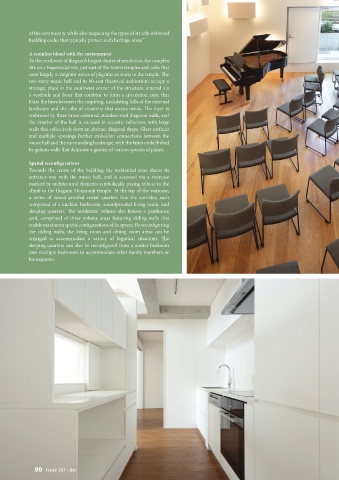
           two-story music hall and its 80-seat theatrical auditorium occupy a
           strategic place in the southwest corner of the structure, entered via
           a vestibule and foyer that combine to form a circulation zone that
           blurs the lines between the inspiring, undulating hills of the external
           landscape and the vibe of creativity that awaits inside. The foyer is
           embraced by three brass-coloured, stainless steel diagonal walls, and
           the interior of the hall is encased in acoustic reflectors, with large
           walls that collectively form an abstract diagonal shape. Glass surfaces
           and multiple openings further embolden connections between the
           music hall and the surrounding landscape, with the latter embellished
           by gabion walls that delineate a garden of various species of plants.

           Spatial reconfigurations
           Towards the centre of the building, the residential zone shares its
           entrance-way with the music hall, and is accessed via a staircase
           marked by architectural elements symbolically paying tribute to the
           climb to the Ikegami Honmonji temple. At the top of the staircase,
           a series of sound-proofed rental quarters line the corridor, each
           comprised of a kitchen, bathroom, soundproofed living room, and
           sleeping quarters. The residential volume also houses a penthouse
           unit, comprised of three volume areas featuring sliding walls that
           enable maximum spatial configurations of its spaces. By reconfiguring
           the sliding walls, the living room and dining room areas can be
           enlarged to accommodate a variety of logistical situations. The
           sleeping quarters can also be reconfigured from a master bedroom
           into multiple bedrooms to accommodate other family members or
           houseguests.


             90     Issue 261 • dw

