


Page 40 - Designing Ways 262
P. 40
MORE
              TEXTURES


                More Textures


                by Stienie Greyling


                 exture is, quite simply, an
                 object’s physical feeling or visual
           Tappearance.  Everything from a
           nubby bouclè throw to a cane screen and
           a suede wall to a stone backsplash count
           as texture in a space.

           What are the four different types of
           texture?
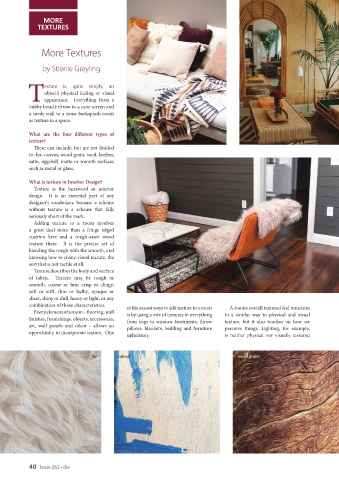
             These can include, but are not limited
           to: fur, canvas, wood grain, sand, leather,
           satin, eggshell, matte or smooth surfaces
           such as metal or glass.

           What is texture in Interior Design?
             Texture  is  the  buzzword  in  interior
           design.  It is an essential part of any
           designer's vocabulary, because a scheme
           without  texture  is  a  scheme  that  falls
           seriously short of the mark.
             Adding texture to a room involves
           a great deal more than a fringe edged
           cushion here and a rough-sawn wood
           texture there.  It is the precise art of
           blending the rough with the smooth, and
           knowing how to create visual texture, the
           sort that is not tactile at all.
             Texture describes the body and surface
           of fabric.  Texture may be rough or
           smooth, coarse or fine, crisp or clingy,
           soft or stiff, thin or bulky, opaque or
           sheer, shiny or dull, heavy or light, or any
           combination of these characteristics.  of the easiest ways to add texture to a room   A room’s overall textured feel translates
             Every element of a room – flooring, wall   is by using a mix of textures in everything   in a similar way to physical and visual
           finishes, furnishings, objects, accessories,   from rugs to window treatments, throw   texture, but it also touches on how we
           art, wall panels and décor - allows an   pillows, blankets,  bedding and  furniture   perceive things.  Lighting,  for example,
           opportunity to incorporate texture.  One
                                              upholstery.                       is neither physical nor visually textured


                                 fur      canvas                                     wood grain


           40     Issue 262 • dw

