


Page 17 - Designing Ways 264
P. 17
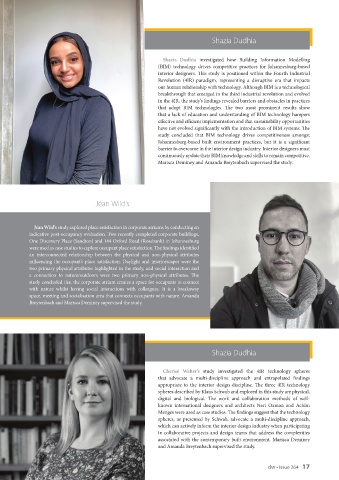
Shazia Dudhia


                                                          Shazia Dudhia investigated how Building Information Modelling
                                                         (BIM) technology drives competitive practices  for Johannesburg-based
                                                         interior designers. This study is positioned within the Fourth Industrial
                                                         Revolution  (4IR)  paradigm,  representing  a  disruptive  era  that  impacts
                                                         our human relationship with technology. Although BIM is a technological
                                                         breakthrough that emerged in the third industrial revolution and evolved
                                                         in the 4IR, the study’s findings revealed barriers and obstacles in practices
                                                         that adopt BIM technologies. The two most prominent results show
                                                         that a lack of education and understanding of BIM technology hampers
                                                         effective and efficient implementation and that sustainability opportunities
                                                         have not evolved significantly with the introduction of BIM systems. The
                                                         study concluded that BIM technology drives competitiveness amongst
                                                         Johannesburg-based built environment practices, but it is a significant
                                                         barrier to overcome in the interior design industry. Interior designers must
                                                         continuously update their BIM knowledge and skills to remain competitive.
                                                         Marisca Deminey and Amanda Breytenbach supervised the study.


                                   Jéan Wiid’s


             Jéan Wiid’s study explored place satisfaction in corporate atriums by conducting an
           indicative post-occupancy evaluation. Two recently completed corporate buildings,
           One Discovery Place (Sandton) and 144 Oxford Road (Rosebank) in Johannesburg
           were used as case studies to explore occupant place satisfaction. The findings identified
           an interconnected relationship between the physical and non-physical attributes
           influencing the occupant’s place satisfaction. Daylight and interiorscapes were the
           two primary physical attributes highlighted in the study, and social interaction and
           a  connection  to  nature/outdoors  were two  primary  non-physical attributes. The
           study concluded that the corporate atrium creates a space for occupants to connect
           with nature  whilst  having  social  interactions  with  colleagues.  It  is  a  breakaway
           space, meeting and socialisation area that connects occupants with nature. Amanda
           Breytenbach and Marisca Deminey supervised the study.


                                                                           Shazia Dudhia


                                                          Cherisé Walter’s  study investigated the 4IR technology spheres
                                                         that  advocate  a  multi-discipline  approach and  extrapolated  findings
                                                         appropriate to the interior design discipline. The three 4IR technology
                                                         spheres described by Klaus Schwab and explored in this study are physical,
                                                         digital and biological. The work and collaboration methods of well-
                                                         known  international  designers  and  architects  Neri  Oxman  and  Achim
                                                         Menges were used as case studies. The findings suggest that the technology
                                                         spheres, as presented by Schwab, advocate a multi-discipline approach,
                                                         which can actively inform the interior design industry when participating
                                                         in collaborative projects and design teams that address the complexities
                                                         associated with the contemporary built environment. Marisca Deminey
                                                         and Amanda Breytenbach supervised the study.


                                                                                                    dw • Issue 264   17

