


Page 26 - Designing Ways 264
P. 26
INSTITUTIONAL
            ARCHITECTURE


            Tinker imagineers design new exhibition in

               most interactive museum in the world


               New Media Museum of the Netherlands Institute for

                Sound & Vision open to the public after renovation


                 he new Media Museum of Sound   selling and playing. Visitors get to play
                 & Vision reopened to the public   interactives, explore iconic media objects,
           Ton Saturday 11 February after     and rediscover nostalgic footage from
           two and a half years of renovations. The   their  youth.  A  visit  to  the  experience  is
           new immersive experience is all about   an educational and inspiring journey of
           placing media culture in perspective.   discovery through the media landscape of
           The media determine us and vice versa.   the past, present and future.
           It is the very first museum in the world
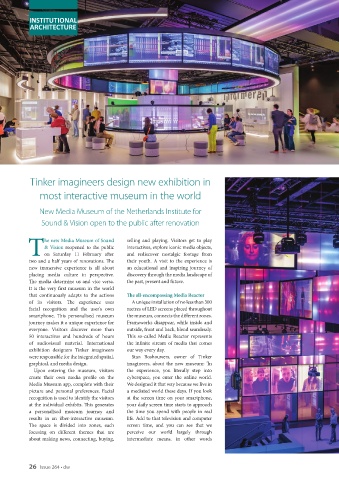
           that continuously adapts to the actions   The all-encompassing Media Reactor
           of  its  visitors.  The  experience  uses   A unique installation of no less than 300
           facial recognition and the user's own   metres of LED screens placed throughout
           smartphone. This personalised museum   the museum, connects the different zones.
           journey makes it a unique experience for   Frameworks disappear, while inside and
           everyone. Visitors discover more than   outside, front and back, blend seamlessly.
           50 interactives and hundreds of hours   This  so-called Media  Reactor  represents
           of audiovisual material. International   the infinite stream of media that comes
           exhibition designers Tinker imagineers   our way every day.
           were responsible for the integrated spatial,   Stan Boshouwers, owner of Tinker
           graphical, and media design.       imagineers, about the new museum: 'In
             Upon entering the museum, visitors   the  experience,  you  literally  step  into
           create their own media profile on the   cyberspace, you enter the online world.
           Media Museum app, complete with their   We designed it that way because we live in
           picture and personal preferences. Facial   a mediated world these days. If you look
           recognition is used to identify the visitors   at the screen time on your smartphone,
           at the individual exhibits. This generates   your daily screen time starts to approach
           a personalised museum journey and   the time you spend with people in real
           results in an über-interactive museum.   life. Add to that television and computer
           The space is divided into zones, each   screen  time,  and  you  can  see  that  we
           focusing on different themes that are   perceive our  world  largely through
           about making news, connecting, buying,   intermediate means, in other words


           26     Issue 264 • dw

