


Page 51 - Designing Ways 266
P. 51
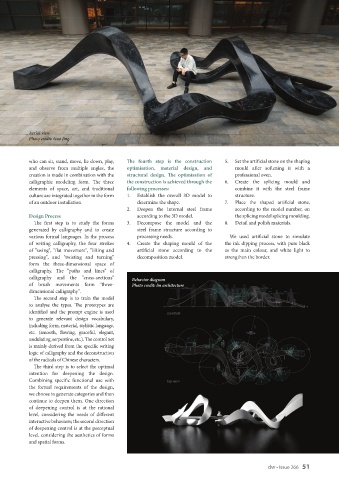
Aerial view
           Photo credit: Guo Jing


           who can sit, stand, move, lie down, play,   The fourth step is the construction   5.   Set the artificial stone on the shaping
           and observe from multiple angles, the   optimisation, material design, and   mould after softening it with a
           creation is made in combination with the   structural design. The optimisation of   professional oven.
           calligraphic modeling form. The three   the construction is achieved through the   6.   Create  the  splicing  mould  and
           elements of space, art, and traditional   following processes:           combine it with the steel frame
           culture are integrated together in the form   1.   Establish the overall 3D model to   structure.
           of an outdoor installation.           determine the shape.           7.   Place the shaped artificial stone,
                                              2.   Deepen the internal steel frame   according to the model number, on
           Design Process                        according to the 3D model.         the splicing model splicing moulding.
             The first step is to study the forms   3.   Decompose the model and the   8.   Detail and polish materials.
           generated by calligraphy and to create   steel frame structure according to
           various formal languages. In the process   processing needs.           We used artificial stone to simulate
           of  writing  calligraphy,  the  four  strokes   4.   Create the shaping mould of the   the ink dipping process, with pure black
           of "swing", "flat movement", "lifting and   artificial stone according to the   as the main colour, and white light to
           pressing", and "twisting and turning"   decomposition model.         strengthen the border.
           form  the  three-dimensional space of
           calligraphy. The "paths and lines" of
           calligraphy and the "cross-sections"   Behavior diagram
           of  brush  movements  form  "three-  Photo credit: lin architecture
           dimensional calligraphy".
             The second step is to train the model
           to analyse the types. The prototypes are
           identified and the prompt engine is used
           to generate relevant design vocabulary,
           including form, material, stylistic language,
           etc. (smooth, flowing, graceful, elegant,
           undulating, serpentine, etc.). The control net
           is mainly derived from the specific writing
           logic of calligraphy and the deconstruction
           of the radicals of Chinese characters.
             The third step is to select the optimal
           intention for deepening the design.
           Combining specific functional use with
           the formal requirements of the design,
           we choose to generate categories and then
           continue to deepen them. One direction
           of  deepening control is  at  the  rational
           level, considering the needs of different
           interactive behaviors; the second direction
           of deepening control is at the perceptual
           level, considering the aesthetics of forms
           and spatial forms.


                                                                                                    dw • Issue 266   51

