


Page 81 - Designing Ways 266
P. 81
Building the “Village Light” from the inside out
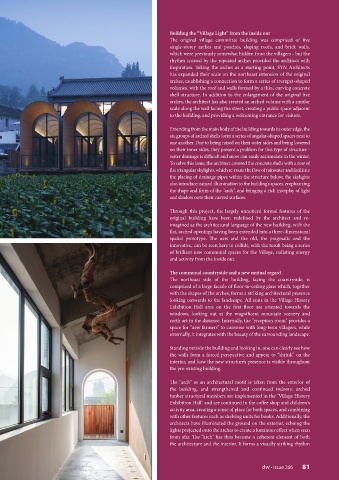
                                                             The original village committee building was comprised of five
                                                             single-storey arches and porches, sloping roofs, and brick walls,
                                                             which were previously somewhat hidden from the villagers - but the
                                                             rhythm created by the repeated arches provided the architect with
                                                             inspiration. Taking the arches as a starting point, SYN Architects
                                                             has expanded their scale on the northeast extension of the original
                                                             arches, establishing a connection to form a series of trumpet-shaped
                                                             volumes, with the roof and walls formed by a thin, curving concrete
                                                             shell structure. In addition to the enlargement of the original five
                                                             arches, the architect has also created an arched volume with a similar
                                                             scale along the wall facing the street, creating a public space adjacent
                                                             to the building, and providing a welcoming entrance for visitors.


                                                             Extending from the main body of the building towards its outer edge, the
                                                             six groups of arched shells form a series of angular-shaped spaces next to
                                                             one another. Due to being raised on their outer sides and being lowered
                                                             on their inner sides, they present a problem for this type of structure -
                                                             water drainage is difficult and snow can easily accumulate in the winter.
                                                             To solve this issue, the architect covered the concrete shells with a row of
                                                             flat triangular skylights, which re-route the flow of rainwater and facilitate
                                                             the placing of drainage pipes within the structure below; the skylights
                                                             also introduce natural illumination to the building’s spaces, emphasizing
                                                             the shape and form of the "arch", and bringing a rich interplay of light
                                                             and shadow onto their curved surfaces.


                                                             Through this project, the largely unnoticed formal features of the
                                                             original building have been redefined by the architect and re-
                                                             imagined as the architectural language of the new building, with the
                                                             flat, arched openings having been extended into a three-dimensional
                                                             spatial  prototype.  The  new  and  the  old,  the  pragmatic  and  the
                                                             innovative, can be seen here to collide, with the result being a series
                                                             of brilliant new communal spaces for the Village, radiating energy
                                                             and activity from the inside out.

                                                             The communal countryside and a new mutual regard
                                                             The northeast side of the building, facing the countryside, is
                                                             comprised of a large facade of floor-to-ceiling glass which, together
                                                             with the shapes of the arches, forms a striking architectural presence
                                                             looking outwards to the landscape. All seats in the Village History
                                                             Exhibition Hall area on the first floor are oriented towards the
                                                             windows, looking out at the magnificent mountain scenery and
                                                             earth art in the distance. Internally, the "reception room" provides a
                                                             space for "new farmers" to converse with long-term villagers, while
                                                             externally, it integrates with the beauty of the surrounding landscape.


                                                             Standing outside the building and looking in, one can clearly see how
                                                             the walls form a forced perspective and appear to “shrink” on the
                                                             interior, and how the new structure’s presence is visible throughout
                                                             the pre-existing building.

                                                             The "arch" as an architectural motif is taken from the exterior of
                                                             the building, and strengthened and continued indoors: arched
                                                             timber structural members are implemented in the "Village History
                                                             Exhibition Hall" and are continued in the coffee shop and children's
                                                             activity area, creating a sense of place for both spaces, and combining
                                                             with other features such as shelving units for books. Additionally, the
                                                             architects have illuminated the ground on the exterior, echoing the
                                                             lights projected onto the arches to create a luminous effect when seen
                                                             from afar. The “arch" has thus become a coherent element of both
                                                             the architecture and the interior. It forms a visually striking rhythm


                                                                                                  dw • Issue 266  81

