


Page 85 - Designing Ways 267
P. 85
The glass bays with fixed glazing and MicroShade solar protection
                                                             additionally accentuate the façades; these are one-storey in the case
                                                             of the Solitaire building, and two-storey in the case of the Carré. The
                                                             remaining windows are fitted with anti-glare protection and external
                                                             sun protectors.

                                                             Hybrid-timber construction
                                                             The construction of the buildings focused on reducing the CO2
                                                             footprint as much as possible, especially in terms of the weight of
                                                             the complex, and on using sustainable materials that can be recycled
                                                             according to the cradle-to-cradle principle. EDGE Suedkreuz
                                                             Berlin is the first project in Germany to be recorded for building
                                                             construction with a 100% match on the MADASTER material
                                                             database. It has a material passport that allows the materials used to
                                                             be reused and recycled.

                                                             The use of prefabricated modules had a positive impact on various
                                                             aspects of the construction process. The wooden elements, such as
                                                             wall and ceiling modules, were prefabricated, then assembled and
                                                             adjusted on the building site. This ensured a precise construction
                                                             schedule and an especially time-efficient and economical
                                                             construction process. The wall elements were made regionally in
                                                             Neuruppin; the ceiling elements in Lemwerder and Henningsdorf.
                                                             Altogether, 1190 wood-hybrid ceiling elements, carried by 1280
                                                             glulam façade supports, and 445 multibox wall elements with a total
                                                             area of 16,000 m² were made.
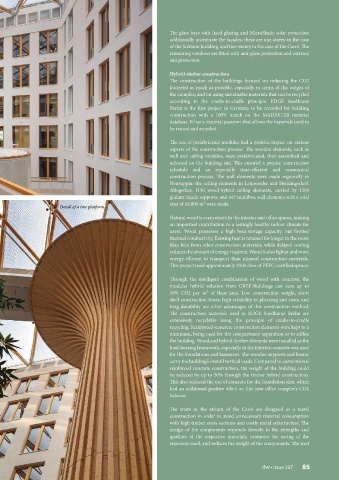
                      Detail of a tree platform.
                                                             Natural wood is everywhere in the interior and office spaces, making
                                                             an important contribution to a lastingly healthy indoor climate for
                                                             users. Wood possesses a high heat-storage capacity, but limited
                                                             thermal conductivity. Existing heat is retained for longer in the room
                                                             than heat from other construction materials, while delayed cooling
                                                             reduces the amount of energy required. Wood is also lighter and more
                                                             energy-efficient  to  transport  than  mineral  construction  materials.
                                                             This project used approximately 3500 cbm of PEFC-certified spruce.

                                                             Through the intelligent combination of wood with concrete, the
                                                             modular hybrid solution from CREE-Buildings can save up to
                                                             50% CO2 per m² of floor area. Low construction weight, short
                                                             shell construction times, high reliability in planning and costs, and
                                                             long durability are other  advantages of this  construction  method.
                                                             The construction materials used in EDGE Suedkreuz Berlin are
                                                             extensively  recyclable  using  the  principle  of  cradle-to-cradle
                                                             recycling. Reinforced-concrete construction elements were kept to a
                                                             minimum, being used for fire compartment separation or to stiffen
                                                             the building. Wood and hybrid-timber elements were installed as the
                                                             load-bearing framework, especially in the interior; concrete was used
                                                             for the foundations and basement. The wooden supports and beams
                                                             carry the building’s overall vertical loads. Compared to conventional
                                                             reinforced concrete construction, the weight of the building could
                                                             be reduced by up to 50% through the timber hybrid construction.
                                                             This also reduced the use of concrete for the foundation slab, which
                                                             had an additional positive effect on this new office complex’s CO2
                                                             balance.

                                                             The stairs in the atrium of the Carré are designed as a metal
                                                             construction in order to avoid unnecessary material consumption
                                                             with high timber cross-sections and costly metal substructure. The
                                                             design  of  the  components  responds  directly  to  the  strengths  and
                                                             qualities of the respective materials, promotes the saving of the
                                                             resources used, and reduces the weight of the components. The roof


                                                                                                  dw • Issue 267  85

