


Page 77 - Designing Ways 272
P. 77
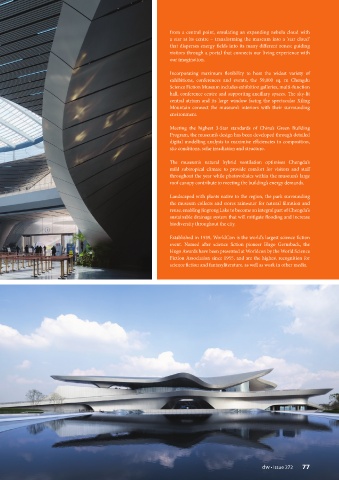
from a central point, emulating an expanding nebula cloud with
                                                             a star at its centre – transforming the museum into a ‘star cloud’
                                                             that disperses energy fields into its many different zones; guiding
                                                             visitors through a portal that connects our living experience with
                                                             our imagination.

                                                             Incorporating maximum flexibility to host the widest variety of
                                                             exhibitions, conferences and events, the 59,000 sq. m Chengdu
                                                             Science Fiction Museum includes exhibition galleries, multi-function
                                                             hall, conference centre and supporting ancillary spaces. The sky-lit
                                                             central atrium and its large window facing the spectacular Xiling
                                                             Mountain connect the museum’s interiors with their surrounding
                                                             environment.

                                                             Meeting  the  highest  3-Star  standards  of  China’s  Green  Building
                                                             Program, the museum’s design has been developed through detailed
                                                             digital modelling analysis to maximise efficiencies in composition,
                                                             site conditions, solar irradiation and structure.

                                                             The museum’s natural hybrid ventilation optimises Chengdu’s
                                                             mild subtropical climate to provide comfort for visitors and staff
                                                             throughout the year while photovoltaics within the museum’s large
                                                             roof canopy contribute to meeting the building’s energy demands.

                                                             Landscaped with plants native to the region, the park surrounding
                                                             the museum collects and stores rainwater for natural filtration and
                                                             reuse, enabling Jingrong Lake to become an integral part of Chengdu’s
                                                             sustainable drainage system that will mitigate flooding and increase
                                                             biodiversity throughout the city.

                                                             Established in 1939, WorldCon is the world’s largest science fiction
                                                             event. Named after science fiction pioneer Hugo Gernsback, the
                                                             Hugo Awards have been presented at Worldcon by the World Science
                                                             Fiction Association since 1955, and are the highest recognition for
                                                             science fiction and fantasyliterature, as well as work in other media.


                                                                                                  dw • Issue 272  77

