


Page 92 - Designing Ways 272
P. 92
In balance between history and contemporaneity.
           The project was conceived with the aim of finding a balance between
           two contrasting tensions: on the one hand, the desire to evoke history
           and the essence of objects and the home; on the other hand, the choice
           to create new geometries using graphic elements and contemporary
           materials.

           Architects Alessandra Castelbarco and Marco Di Nallo have
           established a connection between the taste and design philosophy of
           the creators of the selected furniture pieces, aiming to create a dialogue
           with each object and seamlessly integrate them into the new domestic
           space. The apartment is not merely a neutral container in which to
           “display” the furniture pieces; on the contrary, what PLUS ULTRA
           aimed to create is an environment that not only welcomes them but
           also serves as their counterpoint, combining their distinctive qualities
           with a cohesive design vision.

           The layout, characterised by contemporary graphic and material
           accents, subtly enters the composition, only to later assume a
           prominent role. The work on distribution, geometries, colours, and
           textures initially defines a sort of connective fabric that emerges as
           the true architectural intervention: understated, sophisticated, and
           purposeful.

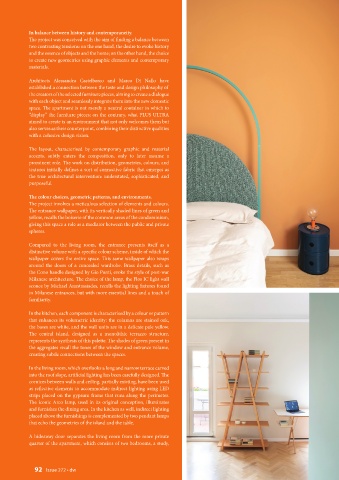
           The colour choices, geometric patterns, and environments.
           The project involves a meticulous selection of elements and colours.
           The entrance wallpaper, with its vertically shaded lines of green and
           yellow, recalls the boiserie of the common areas of the condominium,
           giving this space a role as a mediator between the public and private
           spheres.

           Compared to the living room, the entrance presents itself as a
           distinctive volume with a specific colour scheme, inside of which the
           wallpaper covers the entire space. This same wallpaper also wraps
           around the doors of a concealed wardrobe. Brass details, such as
           the Cono handle designed by Gio Ponti, evoke the style of post-war
           Milanese architecture. The choice of the lamp, the Flos IC light wall
           sconce by Michael Anastassiades, recalls the lighting fixtures found
           in Milanese entrances, but with more essential lines and a touch of
           familiarity.

           In the kitchen, each component is characterised by a colour or pattern
           that enhances its volumetric identity: the columns are stained oak,
           the bases are white, and the wall units are in a delicate pale yellow.
           The  central  island, designed  as a  monolithic  terrazzo  structure,
           represents the synthesis of this palette. The shades of green present in
           the aggregates recall the tones of the window and entrance volume,
           creating subtle connections between the spaces.

           In the living room, which overlooks a long and narrow terrace carved
           into the roof slope, artificial lighting has been carefully designed. The
           cornices between walls and ceiling, partially existing, have been used
           as reflective elements to accommodate indirect lighting using LED
           strips placed on the gypsum frame that runs along the perimeter.
           The iconic Arco lamp, used in its original conception, illuminates
           and furnishes the dining area. In the kitchen as well, indirect lighting
           placed above the furnishings is complemented by two pendant lamps
           that echo the geometries of the island and the table.

           A hideaway door separates the living room from the more private
           quarter of the apartment, which consists of two bedrooms, a study,


             92     Issue 272 • dw

