


Page 80 - Designing Ways 285
P. 80
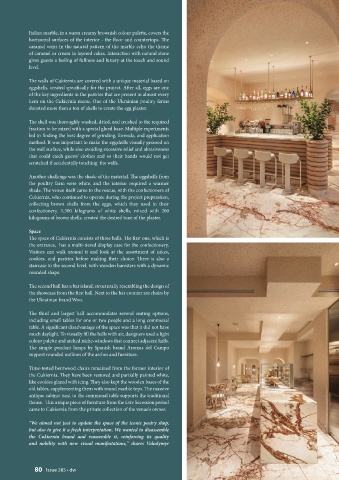
Italian marble, in a warm creamy brownish colour palette, covers the
           horizontal surfaces of the interior - the floor and countertops. The
           caramel veins in the natural pattern of the marble echo the theme
           of caramel or cream in layered cakes. Interaction with natural stone
           gives guests a feeling of fullness and luxury at the touch and sound
           level.

           The walls of Cukiernia are covered with a unique material based on
           eggshells, created specifically for the project. After all, eggs are one
           of the key ingredients in the pastries that are present in almost every
           item on the Cukiernia menu. One of the Ukrainian poultry farms
           donated more than a ton of shells to create the egg plaster.

           The shell was thoroughly washed, dried, and crushed to the required
           fraction to be mixed with a special glued base. Multiple experiments
           led to finding the best degree of grinding, formula, and application
           method. It was important to make the eggshells visually gessoed on
           the wall surface, while also avoiding excessive relief and abrasiveness
           that could catch guests' clothes and so their hands would not get
           scratched if accidentally touching  the walls.

           Another challenge was the shade of the material. The eggshells from
           the poultry farm were white, and the interior required a warmer
           shade. The venue itself came to the rescue, with the confectioners of
           Cukiernia, who continued to operate during the project preparation,
           collecting brown shells from the eggs, which they used in their
           confectionery. 1,300 kilograms of white shells, mixed with 200
           kilograms of brown shells, created the desired tone of the plaster.

           Space
           The space of Cukiernia consists of three halls. The first one, which is
           the entrance,  has a multi-tiered display case for the confectionery.
           Visitors can walk around it and look at the assortment of cakes,
           cookies, and pastries before making their choice. There is also a
           staircase to the second level, with wooden banisters with a dynamic
           rounded shape.

           The second hall has a bar island, structurally resembling the design of
           the showcase from the first hall. Next to the bar counter are chairs by
           the Ukrainian brand Woo.

           The third and largest hall accommodates several seating options,
           including small tables for one or two people and a long communal
           table. A significant disadvantage of the space was that it did not have
           much daylight. To visually fill the halls with air, designers used a light
           colour palette and arched niche-windows that connect adjacent halls.
           The simple pendant lamps by Spanish brand Aromas del Campo
           support rounded outlines of the arches and furniture.

           Time-tested bentwood chairs remained from the former interior of
           the Cukiernia. They have been restored and partially painted white,
           like cookies glazed with icing. They also kept the wooden bases of the
           old tables, supplementing them with round marble tops. The massive
           antique cabinet next to the communal table supports the traditional
           theme.  This unique piece of furniture from the Lviv Secession period
           came to Cukiernia from the private collection of the venue's owner.

           "We aimed not just to update the space of the iconic pastry shop,
           but also to give it a fresh interpretation. We wanted to disassemble
           the Cukiernia brand and reassemble it, reinforcing its quality
           and nobility with new visual manifestations," shares Volodymyr


             80     Issue 285 • dw

