


Page 99 - Designing Ways 288
P. 99
Lambert & Fils Introduces Ipoli: A Bright

                        and Lively New Collection


                                  Montreal, Canada


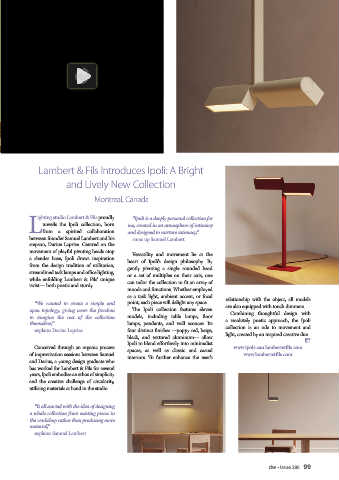
              igh  ting studio Lambert & Fils proudly   “Ipoli is a deeply personal collection for
                unveils  the  Ipoli  collection,  born   me, created in an atmosphere of intimacy
           Lfrom a spirited collaboration     and designed to nurture intimacy,”
           between founder Samuel Lambert and his   sums up Samuel Lambert.
           stepson, Darius Laprise. Centred on the
           movement of playful pivoting heads atop   Versatility and movement lie at the
           a slender base, Ipoli draws inspiration   heart of Ipoli’s design philosophy. By
           from the design tradition of utilitarian,   gently pivoting a single rounded head
           streamlined task lamps and office lighting,   or a set of multiples on their axis, one
           while enfolding Lambert & Fils' unique   can tailor the collection to fit an array of
           twist — both poetic and sturdy.
                                              moods and functions. Whether employed
                                              as  a  task  light,  ambient  accent,  or  focal
             “We wanted to create a simple and   point, each piece will delight any space.  relationship with the object, all models
           open topology, giving users the freedom   The Ipoli collection features eleven   are also equipped with touch dimmers.
           to imagine the rest of the collection   models,  including table  lamps,  floor   Combining thoughtful design with
           themselves,”                       lamps, pendants, and wall sconces. Its   a resolutely poetic approach, the Ipoli
             explains Darius Laprise.         four distinct finishes —poppy red, beige,   collection  is  an ode  to  movement  and
                                              black, and textured aluminum— allow   light, created by an inspired creative duo.
                                              Ipoli to blend effortlessly into minimalist                   dw
             Conceived through an organic process                                  www.ipoli-can.lambertetfils.com
           of improvisation sessions between Samuel   spaces, as well as classic and casual   www.lambertetfils.com
                                              interiors. To further enhance the user’s
           and Darius, a young design graduate who
           has worked for Lambert & Fils for several
           years, Ipoli embodies an ethos of simplicity
           and the creative challenge of circularity,
           utilising materials at hand in the studio.


             “It all started with the idea of designing
           a whole collection from existing pieces in
           the workshop rather than producing more
           material,”
             explains Samuel Lambert.


                                                                                                    dw • Issue 288   99

