


Page 84 - Designing Ways 238
P. 84
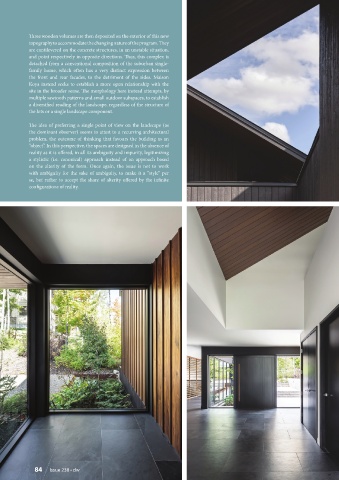
Three wooden volumes are then deposited on the exterior of this new
           topography to accommodate the changing nature of the program. They
           are cantilevered on the concrete structures, in an unstable situation,
           and point respectively in opposite directions. Thus, this complex is
           detached from a conventional composition of the suburban single-
           family home, which often has a very distinct expression between
           the front and rear facades, to the detriment of the sides. Maison
           Koya instead seeks to establish a more open relationship with the
           site in the broader sense. The morphology here instead attempts, by
           multiple sawtooth patterns and small outdoor subspaces, to establish
           a diversified reading of the landscape, regardless of the structure of
           the lots or a single landscape component.

           The idea of preferring a single point of view on the landscape (as
           the dominant observer) seems to attest to a recurring architectural
           problem, the outcome of thinking that favours the building as an
           “object”. In this perspective, the spaces are designed in the absence of
           reality as it is offered, in all its ambiguity and impurity, legitimizing
           a stylistic (i.e. canonical) approach instead of an approach based
           on the alterity of the form. Once again, the issue is not to work
           with ambiguity for the sake of ambiguity, to make it a “style” per
           se, but rather to accept the share of alterity offered by the infinite
           configurations of reality.


             84     Issue 238 • dw

