


Page 85 - Designing Ways 238
P. 85
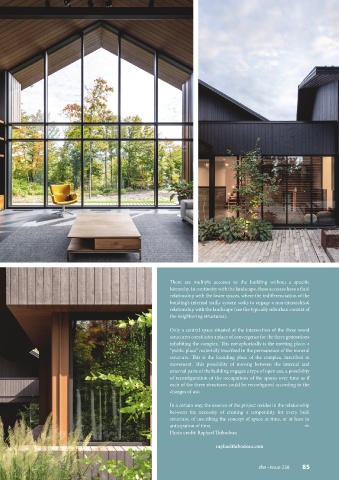
There are multiple accesses to the building without a specific
                                                             hierarchy. In continuity with the landscape, these accesses have a fluid
                                                             relationship with the lower spaces, where the indifferenciation of the
                                                             building’s internal traffic system seeks to engage a non-hierarchical
                                                             relationship with the landscape (see the typically suburban context of
                                                             the neighboring structures).


                                                             Only a central space situated at the intersection of the three wood
                                                             structures constitutes a place of convergence for the three generations
                                                             inhabiting the complex. This metaphorically is the meeting place, a
                                                             “public place” materially inscribed in the permanence of the mineral
                                                             structure. This is the founding place of the complex, inscribed in
                                                             movement. This possibility  of moving between the  internal  and
                                                             external parts of the building engages a type of open use, a possibility
                                                             of reconfiguration of the occupations of the spaces over time as if
                                                             each of the three structures could be reconfigured according to the
                                                             changes of use.

                                                             In a certain way, the essence of the project resides in the relationship
                                                             between the necessity of creating a temporality for every built
                                                             structure, of inscribing the concept of space in time, or at least in
                                                             anticipation of time.                          dw
                                                             Photo credit: Raphael Thibodeau

                                                                             raphaelthibodeau.com


                                                                                                dw • Issue 238  85

