


Page 94 - Designing Ways 238
P. 94
Marconi Residence


                                      Montréal, Canada


               ituated in the eclectic Marconi-Alexandra neighbourhood, the
               project takes advantage of unusual urban conditions such as
           Ssurrounding garages, train tracks, an adjacent laneway. Rather
           than being seen as negative, these elements are incorporated to the
           project beneficially.

           A unique urban context
           On Marconi street, scattered residences punctuate an urban fabric
           essentially composed of car repair shops, small industrial buildings
           and workshops. Built-in 1910, the original building was a typical
           Montreal one-storey bungalow with a flat roof, commonly referred
           to as “shoeboxes”. Despite being located in an area where housing is
           prohibited according to the zoning plan, the house had a vested right
           to be modified or extended. The client’s request was to renovate the
           house and expand it to accommodate a small family. A number of
           factors led to the decision of preserving the existing one-storey volume
           of the building. First, it was important to maintain the sequence of
           aligned shoeboxes present on the street. Secondly, “shoeboxes” as a
           typology are slowly disappearing from the city’s landscape and being
           replaced with denser two to three storey buildings. The project was an
           opportunity to develop an alternative approach for these types of one
           storey buildings. Therefore, despite the proximity of the train tracks
           in the back, the addition takes advantage of the depth of the lot rather
           than its height.

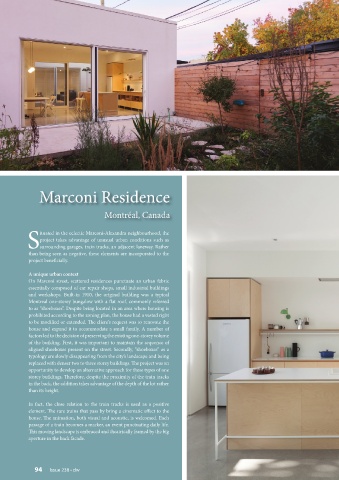
           In fact, the close relation to the train tracks is used as a positive
           element. The rare trains that pass by bring a cinematic effect to the
           house. The animation, both visual and acoustic, is welcomed. Each
           passage of a train becomes a marker, an event punctuating daily life.
           This moving landscape is embraced and theatrically framed by the big
           aperture in the back facade.


             94     Issue 238 • dw

