


Page 97 - Designing Ways 238
P. 97
this articulation to mark the programmatic transition from the living
                                                             room and the passageway to the kitchen. The staircase leading to the
                                                             basement is also carefully inserted in this central corridor.
                                                             At the southern edge, along the laneway, a past reallotment had
                                                             added a small triangular parcel to the buildable site. This small piece
                                                             of land was just wide enough to create an opening onto the patio
                                                             from the laneway, an opportunity seized in order to activate the inner
                                                             courtyard. An additional door at the corner of the patio creates a
                                                             second entry and establishes a direct connection between the house
                                                             and the alley. In hindsight, we can say that site constraints, both
                                                             urban and regulatory, became the conceptual catalyst of the project.

                                                             Internal organisation
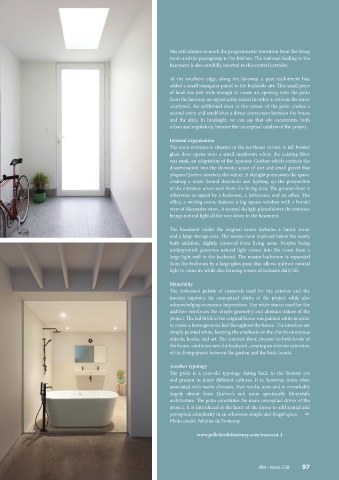
                                                             The main entrance is situated in the northeast corner. A tall frosted
                                                             glass door opens onto a small mudroom where the existing floor
                                                             was sunk, an adaptation of the Japanese Genkan which controls the
                                                             dissemination into the domestic space of dirt and small gravel that
                                                             plagues Quebec streets in the winter. A skylight punctuates the space,
                                                             creating a more formal threshold and lighting up the perspective
                                                             of the entrance when seen from the living area. The ground floor is
                                                             otherwise occupied by a bedroom, a bathroom, and an office. The
                                                             office, a writing room, features a big square window with a frontal
                                                             view of Alexandra street. A second skylight placed above the staircase
                                                             brings natural light all the way down to the basement.


                                                             The basement under the original house includes a family room
                                                             and a large storage area. The master suite is placed below the newly
                                                             built addition, slightly removed from living areas. Despite being
                                                             underground, generous natural light comes into the room from a
                                                             large light well in the backyard. The master bathroom is separated
                                                             from the bedroom by a large glass pane that allows indirect natural
                                                             light to come in, while also framing scenes of intimate daily life.


                                                             Materiality
                                                             The restrained palette of materials used for the exterior and the
                                                             interior supports the conceptual clarity of the project while also
                                                             acknowledging economic imperatives. The white stucco used for the
                                                             addition reinforces the simple geometry and abstract nature of the
                                                             project. The red brick of the original house was painted white in order
                                                             to create a homogeneous feel throughout the house. The interiors are
                                                             simply painted white, keeping the emphasis on the client’s numerous
                                                             objects, books, and art. The concrete floor, present on both levels of
                                                             the house, continues into the backyard, creating an exterior extension
                                                             of the living spaces between the garden and the back facade.


                                                             Another typology
                                                             The patio is a  year-old typology  dating  back  to the Roman era
                                                             and present in many different cultures. It is, however, more often
                                                             associated with warm climates, than nordic ones and is remarkably
                                                             largely absent from Quebec’s and more specifically Montréal’s
                                                             architecture. The patio constitutes the main conceptual driver of the
                                                             project. It is introduced at the heart of the house to add spatial and
                                                             perceptual complexity in an otherwise simple and frugal space.  dw
                                                             Photo credit: Pelletier de Fontenay
                                                                      www.pelletierdefontenay.com/marconi-1


                                                                                                dw • Issue 238  97

