


Page 46 - Designing Ways 260
P. 46
PATTERNS


                Patterns, Colours, Curves & Recycling.


                                 by Stienie Greyling


                 pattern is  a  regularity  in the   colour.   For example, ridges on the sand.
                 world, in human-made design,   Plant material such as foliage, flowers
                 or
           A in abstract ideas.  As such the   and the bark of trees, which show veins,
           element of a pattern repeat in a predictable   stripes, spots and variegation can also be
           manner.  A geometric pattern is a kind of   used to form patterns by repeating them
           pattern formed of geometric shapes and   within the design.  Patterns can be created
           typically repeated like a wallpaper design.   by manipulating plant material.
           Any of the senses may directly observe
           patterns.                          Techniques:
             Patterns provide a sense of order in what   There are many techniques which can
           might otherwise appear chaotic.  Pattern   be used to create patterns.  These can
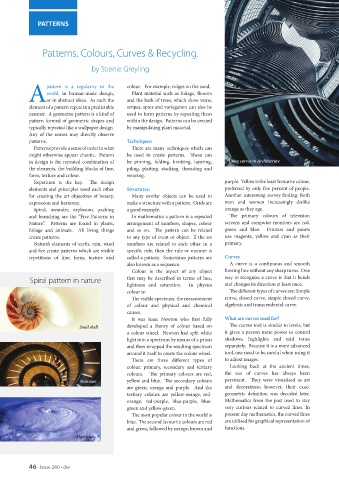
           in design is the repeated combination of   be pinning, folding, knotting, layering,   Using curves in Architecture
           the elements, the building blocks of line,   piling, plaiting, stacking, threading and
           form, texture and colour.          weaving.
             Repetition  is the key.   The  design                              purple.  Yellow is the least favourite colour,
           elements and principles need each other   Structures:                preferred by only five percent of people.
           for  creating  the  art  objectives of  beauty,   Many similar objects can be used to   Another interesting survey finding: Both
           expression and harmony.            make a structure with a pattern.  Grids are   men and women increasingly dislike
             Spiral, meander, explosion, packing   a good example.              orange as they age.
           and branching are the “Five Patterns in   In mathematics a pattern is a repeated   The primary colours of television
           Nature”.  Patterns are found in plants,   arrangement of numbers, shapes, colour   screens and computer monitors are red,
           foliage and animals.  All living things   and so on.  The pattern can be related   green and blue.  Printers and paints
           create patterns.                   to any type of event or object.  If the set   use  magenta,  yellow and  cyan  as  their
             Nature’s elements of earth, rain, wind   numbers are related to each other in a   primary.
           and fire create patterns which are visible   specific rule, then the rule or manner is
           repetitions of line, form, texture and   called a pattern.  Sometimes patterns are   Curves
                                              also known as a sequence.           A curve is a continuous and smooth
                                               Colour  is  the aspect  of  any  object   flowing line without any sharp turns.  One
            Spiral pattern in nature          that may be described in terms of hue,   way to recognise a curve is that it bends
                                              lightness and saturation.  In physics   and changes its direction at least once.
                                              colour is:                          The different types of curves are: Simple
                                               The visible spectrum, the measurement   curve, closed curve, simple closed curve,
                                              of colour and physical and chemical   algebraic and transcendental curve.
                                              causes.
                                               It was Isaac Newton who first fully   What are curves used for?
                             Snail shell      developed a theory of colour based on   The curves tool is similar to levels, but
                                              a colour wheel.  Newton had split white   it gives a person more power to control
                                              light into a spectrum by means of a prism   shadows,  highlights  and mid  tones
                                              and then wrapped the resulting spectrum   separately.  Because it is a more advanced
                                              around it itself to create the colour wheel.  tool, one need to be careful when using it
                                               There  are  three  different  types  of   to adjust images.
                                              colour:  primary,  secondary and  tertiary   Looking back at the ancient times,
                                              colours.   The primary colours are red,   the use of curves has always been
                             Staircase        yellow and blue.  The secondary colours   persistent.  They were visualised as art
                                              are green, orange and purple.  And the   and decorations; however, their exact
                                              tertiary colours are yellow-orange, red-  geometric  definition  was decoded  later.
                                              orange, red-purple, blue-purple, blue-  Mathematics from the past used to stay
                                              green and yellow-green.           very curious related to curved lines. In
                                               The most popular colour in the world is   present day mathematics, the curved lines
                                              blue.  The second favourite colours are red   are utilised for graphical representation of
                                              and green, followed by orange, brown and   functions.
                            Hurricane


           46     Issue 260 • dw

