


Page 23 - Designing Ways 272
P. 23
leaves was viewed as a way of honouring
                                                                                protective qualities of the land across
                                                                                ancient cultures around the world.
                                                                                  In the 1600s, the Portuguese brought their
                                                                                own the Carnival traditions to Brazil when
                                                                                they colonized the country.  Beginning as
                                                                                formal balls among the Portuguese high
                                                                                society, the parties were soon appropriated
                                                                                and overshadowed by the colourful and
                                                                                lively celebrations of the Afro-Brazilians
                                                                                that infused Carnival with dance music
                                                                                and costume.  While initially segregated
                                                                                between the two cultures, the celebrations
                                                                                merged in the 20th century to become the
                                                                                grand festival that fills the street of Rio de
                                                                                Janeiro each year.  Samba music and dance
                                                                                came to define the revelry with samba
                                                                                schools competing in the world renowned
                                                                                Carnival parades, decked out in feathered
                                                                                and ornamental costumes.  Other  cultures
                                                                                across the world have likewise adopted the
                                                                                dramatic fashions for their own Carnival
                                                                                parades and parties each year.
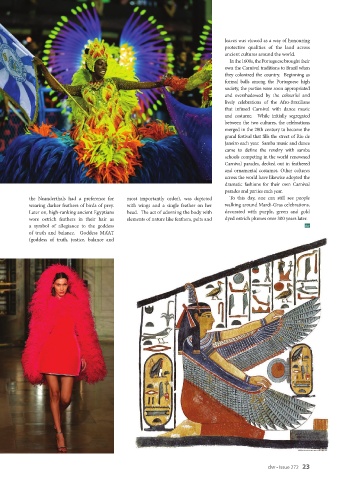
           the Neanderthals had a preference for   most importantly order), was depicted   To this day, one can still see people
           wearing darker feathers of birds of prey.     with wings and a single feather  on her   walking around Mardi-Gras celebrations,
           Later on, high-ranking ancient Egyptians   head.  The act of adorning the body with   decorated with purple, green and gold
           wore ostrich feathers in their hair as   elements of nature like feathers, pelts and   dyed ostrich plumes over 300 years later.
           a symbol of allegiance to the goddess                                                            dw
           of truth and balance.  Goddess MA’AT
           (goddess of truth, justice, balance and


                                                                                                    dw • Issue 272   23

