


Page 92 - Designing Ways 254
P. 92
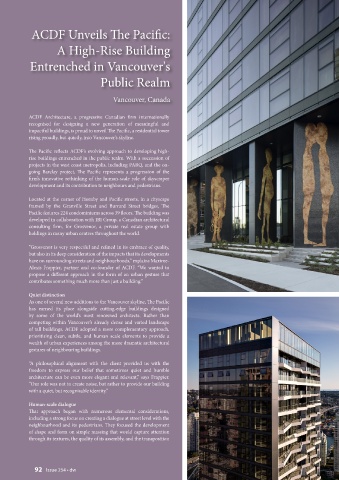
ACDF Unveils The Pacific:

                     A High-Rise Building


            Entrenched in Vancouver's

                                    Public Realm


                                         Vancouver, Canada


           ACDF Architecture, a progressive Canadian firm internationally
           recognised for designing a new generation of meaningful and
           impactful buildings, is proud to unveil The Pacific, a residential tower
           rising proudly, but quietly, into Vancouver’s skyline.

           The Pacific reflects ACDF’s evolving approach to developing high-
           rise buildings entrenched in the public realm. With a succession of
           projects in the west coast metropolis, including PARQ, and the on-
           going Barclay project, The Pacific represents a progression of the
           firm’s innovative rethinking of the human-scale role of skyscraper
           development and its contribution to neighbours and pedestrians.

           Located at the corner of Hornby and Pacific streets, in a cityscape
           framed by the Granville Street and Burrard Street bridges, The
           Pacific features 224 condominiums across 39 floors. The building was
           developed in collaboration with IBI Group, a Canadian architectural
           consulting firm, for Grosvenor, a private real estate group with
           holdings in many urban centres throughout the world.

           “Grosvenor is very respectful and refined in its embrace of quality,
           but also in its deep consideration of the impacts that its developments
           have on surrounding streets and neighbourhoods,” explains Maxime-
           Alexis Frappier, partner and co-founder of ACDF. “We wanted to
           propose a different approach in the form of an urban gesture that
           contributes something much more than just a building.”

           Quiet distinction
           As one of several new additions to the Vancouver skyline, The Pacific
           has earned its place alongside cutting-edge buildings designed
           by some of the world’s most renowned architects. Rather than
           competing within Vancouver’s  already dense  and varied landscape
           of tall buildings, ACDF adopted a more complementary approach,
           prioritising clean, subtle, and human  scale  elements to  provide  a
           wealth of urban experiences among the more dramatic architectural
           gestures of neighbouring buildings.

           “A philosophical  alignment  with the client provided  us  with the
           freedom to express our belief that sometimes quiet and humble
           architecture can be even more elegant and relevant,” says Frappier.
           “Our role was not to create noise, but rather to provide our building
           with a quiet, but recognisable identity.”

           Human-scale dialogue
           That approach began with numerous elemental considerations,
           including a strong focus on creating a dialogue at street level with the
           neighbourhood and its pedestrians. They focused the development
           of shape and form on simple massing that would capture attention
           through its textures, the quality of its assembly, and the transposition


             92     Issue 254 • dw

