


Page 93 - Designing Ways 254
P. 93
of its details. The firm envisioned a structure whose materiality
                                                             would emit its own unique character, while blending into the built,
                                                             environmental, and social fabric of its surroundings.

                                                             In a return to design principles inspired by art, photography, and
                                                             fashion, ACDF’s powerful integration of contrasts paints and
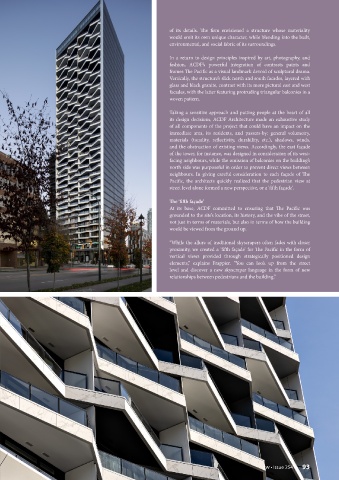
                                                             frames The Pacific as a visual landmark devoid of sculptural drama.
                                                             Vertically, the structure’s slick north and south facades, layered with
                                                             glass and black granite, contrast with its more pictural east and west
                                                             facades, with the latter featuring protruding triangular balconies in a
                                                             woven pattern.

                                                             Taking a sensitive approach and putting people at the heart of all
                                                             its design decisions, ACDF Architecture made an exhaustive study
                                                             of all components of the project that could have an impact on the
                                                             immediate area, its residents, and passers-by: general volumetry,
                                                             materials (tonality, reflectivity, durability, etc.), shadows, winds,
                                                             and the obstruction of existing views. Accordingly, the east façade
                                                             of the tower, for instance, was designed in consideration of its west-
                                                             facing neighbours, while the omission of balconies on the building’s
                                                             north side was purposeful in order to prevent direct views between
                                                             neighbours.  In  giving  careful  consideration  to  each  façade  of  The
                                                             Pacific,  the  architects  quickly  realized  that  the  pedestrian  view  at
                                                             street level alone formed a new perspective, or a 'fifth façade'.

                                                             The ‘fifth façade’
                                                             At its base, ACDF committed to ensuring that The  Pacific was
                                                             grounded to the site’s location, its history, and the vibe of the street,
                                                             not just in terms of materials, but also in terms of how the building
                                                             would be viewed from the ground up.

                                                             “While the allure of traditional skyscrapers often fades with closer
                                                             proximity, we created a ‘fifth façade’ for The Pacific in the form of
                                                             vertical views provided through strategically positioned design
                                                             elements,” explains Frappier. “You can look up from the street
                                                             level and discover a new skyscraper language in the form of new
                                                             relationships between pedestrians and the building.”


                                                                                                  dw • Issue 254  93

