


Page 56 - Designing Ways 261
P. 56
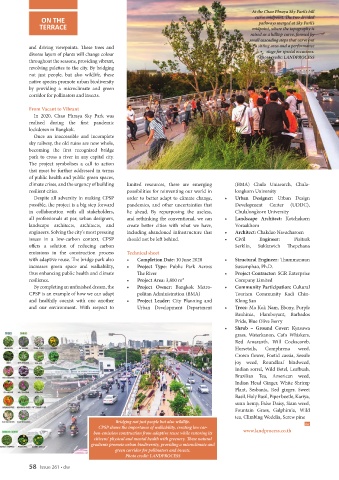
At the Chao Phraya Sky Park’s hill
                ON THE                                                                     curve midpoint. The two divided
                                                                                            pathways merged at Sky Park’s
               TERRACE                                                                    midpoint, where the topography is
                                                                                         raised as a hilltop curve, formed by
                                                                                         small cascading steps that carve out
           and driving viewpoints. These trees and                                         a sitting area and a performance
                                                                                               stage for special occasions.
           diverse layers of plants will change colour                                      Photo credit: LANDPROCESS
           throughout the seasons, providing vibrant,
           revolving palettes to the city. By bridging
           not  just  people,  but  also  wildlife,  these
           native species promote urban biodiversity
           by providing a microclimate and green
           corridor for pollinators and insects.

           From Vacant to Vibrant
             In 2020, Chao Phraya Sky Park was
           realised during the first pandemic
           lockdown in Bangkok.
             Once  an inaccessible and  incomplete
           sky railway, the old ruins are now whole,
           becoming the first recognised bridge
           park to cross a river in any capital city.
           The project symbolises a call to action
           that must be further addressed in terms
           of public health and public green spaces,
           climate crises, and the urgency of building   limited resources, there are emerging   (BMA) Chula Unisearch, Chula-
           resilient cities.                  possibilities for reinventing our world in   longkorn University
             Despite all adversity in making CPSP   order to better adapt to climate change,   •   Urban Designer: Urban Design
           possible, the project is a big step forward   pandemics,  and  other  uncertainties  that   Development  Center  (UDDC),
           in collaboration with all stakeholders,   lie ahead. By repurposing the useless,   Chulalongkorn University
           all professionals at par, urban designers,   and rethinking the conventional, we can   •   Landscape Architect: Kotchakorn
           landscape architects, architects, and   create better cities with what we have,   Voraakhom
           engineers. Solving the city's most pressing   including abandoned infrastructure that   •   Architect: Chakdao Navacharoen
           issues in a low-carbon context, CPSP   should not be left behind.    •   Civil   Engineer:   Pisitsak
           offers a solution of reducing carbon                                     Serklin,  Sukkawich  Thepchana
           emissions in  the construction process   Technical sheet
           with adaptive reuse. The bridge park also   •   Completion Date: 10 June 2020  •   Structural Engineer: Thummanuun
           increases green space and walkability,   •   Project Type: Public Park Across   Susumphao, Ph.D.
           thus enhancing public health and climate   The River                 •   Project Contractor: SGR Enterprise
           resilience.                        •   Project Area: 3,800 m2            Company Limited
             By completing an unfinished dream, the   •   Project Owner:  Bangkok  Metro-  •   Community Participation: Cultural
           CPSP is an example of how we can adapt   politan Administration (BMA)    Tourism Community Kadi Chin-
           and healthily coexist with one another   •   Project Leader: City Planning and   Klong San
           and our environment. With respect to   Urban Development Department   •   Trees: Ma Kok Nam, Ebony, Purple
                                                                                    Bauhinia, Flamboyant, Barbados
                                                                                    Pride, Blue Olive Berry
                                                                                •   Shrub – Ground Cover: Kyasuwa
                                                                                    grass, Waterkanon, Cat's Whiskers,
                                                                                    Red Amaranth, Will Cockscomb,
                                                                                    Horsetails,  Gomphrena  weed,
                                                                                    Crown flower, Foetid cassia, Sessile
                                                                                    joy weed, Roundleaf bindweed,
                                                                                    Indian sorrel, Wild Betel, Leafbush,
                                                                                    Brazilian Tea, American weed,
                                                                                    Indian Head Ginger, White Shrimp
                                                                                    Plant, Sesbania, Red ginger, Sweet
                                                                                    Basil, Holy Basil, Piper beetle, Kariya,
                                                                                    sunn hemp, False Daisy, Siam weed,
                                                                                    Fountain Grass, Galphimia, Wild
                                                                                    tea, Climbing Wedelia, Screw pine
                                          Bridging not just people but also wildlife.                       dw
                                    CPSP shows the importance of walkability, creating low car-
                                  bon-emission construction from adaptive reuse while restoring its   www.landprocess.co.th
                                  citizens' physical and mental health with greenery. These natural
                                 gradients promote urban biodiversity, providing a microclimate and
                                         green corridor for pollinators and insects.
                                             Photo credit: LANDPROCESS

           58     Issue 261 • dw

