


Page 59 - Designing Ways 261
P. 59
experience real life not just with their
                                                                                eyes, but with their bodies and minds.
                                                                                  We hope that people will briefly take
                                                                                their attention off digital devices and
                                                                                come to the pavilions to enjoy the subtle
                                                                                changes of light and shadow created
                                                                                by the pavilions and the surrounding
                                                                                trees, as well as to observe the lovely
                                                                                ambient  environment and  the  children
                                                                                at play. Taking the relationship between
                                                                                humans and nature as an entry point, the
                                                                                installation provides a space for in-person
                                                                                social contact that seeks to examine,
                                                                                explore and empower our shared future.

                                                                                Project Information
                                                                                •   Project name: Dream Glow Pavilion
                                                                                •   Design: Daxing Jizi Design
                                                                                •   Commissioned by: Glow Shenzhen
                                                                                    2021 - Longgang
                                                                                •   Year: 2021
                                                                                •   Size: 270 m2
                                                                                •   Location:  Shenzhen  Universiade
                                                                                    Centre
                                                                                •   Chief designer: ZENG Zhenwei
           Mushrooms & Chinese Lanterns       Space for In-person Social Contact  •   Design Team: ZENG Zhenwei, XIE
             We drew inspiration from the structure   As social media encroaches on our   Muxi
           of traditional Chinese lanterns for the   urban lives, virtual spaces and fragmented   •   Structural designer: LIN Chaowei,
           shape of the pavilions. After thorough   information are keeping us closed up in   FANG Feihu
           study, we borrowed the frame of traditional   our rooms, while the things that connect   •   Illustration designer: SHU Yi
           bamboo lanterns and applied the five   us  and  bring  us  together  are  gradually   •   Public furniture designer: E+UV
           traditional Chinese colours of turquoise,   fading into insignificance. Through the   •   Construction  Team:  Shenzhen
           soft yellow, violet red, mandarin red, and   work, we hope to present a multifaceted   Mantangcai Engineering Co., Ltd.
           jet black in the design. The designers   understanding of how we perceive reality   •   Photographers: ZHANG Chao,
           intended the rounded pavilions to evoke   and nature, and encourage people to   ZHANG Dalian, Daxing Jizi  dw
           our beloved traditional Chinese lanterns
           and to possess the wonderful appeal of
           lovely creatures in nature by resembling
           wild mushrooms from a certain angle.
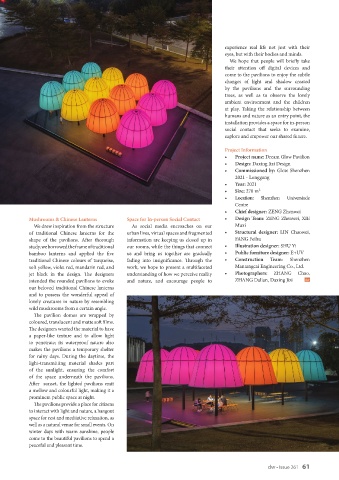
             The pavilion domes are wrapped by
           coloured, translucent and matte soft films.
           The designers wanted the material to have
           a paper-like texture and to allow light
           to  penetrate;  its  waterproof  nature  also
           makes the pavilions a temporary shelter
           for rainy days. During the daytime, the
           light-transmitting material shades part
           of the sunlight, ensuring the comfort
           of the space underneath the pavilions.
           After  sunset, the lighted pavilions emit
           a mellow and colourful light, making it a
           prominent public space at night.
             The pavilions provide a place for citizens
           to interact with light and nature, a hangout
           space for rest and meditative relaxation, as
           well as a natural venue for small events. On
           winter days with warm sunshine, people
           come to the beautiful pavilions to spend a
           peaceful and pleasant time.


                                                                                                    dw • Issue 261   61

